8 exercises to activate blood circulation in the legs
Share
To activate the blood circulation of the legs, the most useful movements are those which mobilize the feet, ankles and calves: ankle flexions, standing on tiptoes, walking or pedaling. Performed regularly, especially when sitting or standing for a long time, they work on the calf muscle pump and promote venous return.
These exercises are simple, require almost no equipment and can be practiced in the office or at home. They contribute to leg comfort, but do not replace diagnosis or treatment when a venous disorder is present.
Why does movement help leg circulation?
The blood sent to the legs must then return to the heart through the venous network, against the flow of gravity. To achieve this, the body relies on the valves located in the veins, but also on the support of the foot and the contraction of the calf muscles.
When you walk or move your ankles, the muscles contract and compress the deep veins. This mechanism helps venous blood move up the leg. Conversely, staying still for several hours reduces the action of this muscle pump and can accentuate feelings of heaviness or tension.
To better understand this mechanism and the factors that can contribute to heavy legs, consult our guide dedicated to venous circulation and heavy legs.
Before you start: three simple rules
- Perform the movements slowly, smoothly and without looking for pain.
- Use a stable chair or wall for support for standing exercises.
- Start gradually and adapt the number of repetitions to your mobility.
If you have a diagnosed venous disease, a heart or respiratory condition, a significant mobility limitation, a recent procedure or pain during exercise, seek advice from a healthcare professional before adopting a new routine.
1. Ankle flexions and extensions in a seated position
This exercise is particularly practical in the office, in the car during a break or during a train or plane journey.
- Sit with your back straight, your feet flat on the floor.
- Keep your heels on the floor and raise your toes toward you.
- Rest your feet, then keep your toes on the floor and lift your heels.
- Alternate these two movements 15 to 20 times, without forcing.
Flexion and extension of the ankle mobilizes the calf and foot muscles. These are the first movements to favor when you sit for a long time.
2. Ankle rotations
Rotations allow the joint to be mobilized in several directions and can easily complement previous flexions.
- Sitting, lift one foot slightly off the ground.
- Slowly draw circles with the tip of your foot.
- Perform 10 rotations in one direction, then 10 in the other.
- Repeat with the other foot.
Keep the leg relaxed and start the movement from the ankle, without rotating the entire knee.
3. The heel-toe rocker to mobilize the feet
This blood circulation exercise for the feet replicates part of the movement performed while walking.
- Place both feet parallel to the floor.
- Raise your heels, leaning on the front of your feet.
- Come back down, then raise your toes, keeping your heels on the ground.
- Perform 15 to 20 repetitions.
You can practice it under a desk, in a waiting room, or when you cannot get up immediately.
4. Tiptoe climbs
In a standing position, this movement places greater strain on the calf muscles.
- Stand straight with your feet hip-width apart.
- Place one hand on a wall or on the back of a stable chair.
- Slowly rise on your tiptoes.
- Hold the position for a second, then gradually lower back down.
- Perform two sets of 10 repetitions according to your abilities.
Avoid bouncing. Both the ascent and descent must remain controlled. If your balance is fragile, keep both hands on a stable support.
5. Seated leg extensions
This variation combines the movement of the knee with that of the ankle and is suitable for days spent in front of a screen.
- Sit at the back of a chair with your back straight.
- Extend one leg in front of you without suddenly locking your knee.
- Bring the tip of your foot toward you, then gently point it forward.
- Rest the leg and switch sides.
- Perform 10 repetitions per leg.
The movement must remain comfortable. Reduce its amplitude if you feel tension in the knee or hip.
6. Walking in place
Walking successively mobilizes the arch of the foot, the ankles and the calves. Even without going out, a few steps can break a period of immobility.
- Stand near support if necessary.
- Walk in place for one to two minutes.
- Unwind your foot and swing your arms naturally.
- Maintain a comfortable pace that allows you to breathe normally.
At work, you can simply get up and walk for a few minutes whenever your organization allows it.
7. Pedaling in a lying position
Pedaling mobilizes the ankles, knees and legs without requiring equipment.
- Lie on your back on a comfortable support.
- Raise your legs, keeping your lower back in a comfortable position.
- Slowly pedal for 30 to 60 seconds.
- Rest your feet, cool down, then repeat once again if you feel comfortable.
Make small circles if the movement pulls on your lower back. Stop exercising if you feel pain.
8. Regular walking
Walking remains the simplest activity to naturally use the calf pump and the support of the foot. Health Insurance recommends, to promote good circulation, 30 minutes of brisk walking at least three times a week and, if possible, every day.
If you return to activity, start with a duration adapted to your physical condition, then gradually increase. It is often more realistic to walk a little each day than to plan a long, occasional session.
Which routine should you choose according to your day?
If you work seated
Regularly perform some ankle flexions, rotations and heel-toe tilts. Get up to walk as soon as possible and avoid keeping your legs crossed for long periods of time.
If you work standing
Avoid freezing or trampling in one place. Alternate a few steps with rising on tiptoes and change your support regularly.
At the end of the day
You can combine a short walk, some pedaling movements and a rest period with your legs slightly elevated. This position may provide temporary comfort, but it does not replace movement during the day.
If feelings of heaviness return regularly, also find out possible causes of heavy legs and situations in which you should consult.
How often should you practice these exercises?
There is no single frequency suitable for everyone. Regularity and interrupted periods of immobility are more important than an occasional intense session.
When you sit or stand for a long time, focus on short series of movements repeated throughout the day. At the same time, maintain regular physical activity adapted to your state of health, in particular walking, swimming, cycling or gentle gymnastics.
Can you massage or elevate your legs after exercises?
If there are no unusual signs, elevating the legs for a few minutes can help with comfort after a day of standing or sitting. A gentle self-massage can also be done by moving up from the ankles to the knees, without excessive pressure.
On the other hand, do not massage a leg that suddenly shows pain, asymmetrical swelling, redness or unusual warmth. These symptoms require rapid medical advice in order to rule out, in particular, phlebitis.
When should you seek medical advice?
Occasional, symmetrical heavy legs can be caused by heat or a still day. However, certain signs should not be attributed to simple “poor circulation”.
Consult quickly in the presence of:
- sudden swelling affecting only one leg or calf;
- severe or unusual pain;
- a red, hot or hard area along the path of a vein;
- a wound that does not heal;
- symptoms that persist or worsen despite daily measures.
In the event of sudden shortness of breath, chest pain, discomfort or sputum containing blood, call 15 or 112 immediately.
To understand the long-lasting symptoms linked to poor vein functioning, consult our article dedicated to chronic venous insufficiency.
Exercises and Veinavital: two complementary approaches
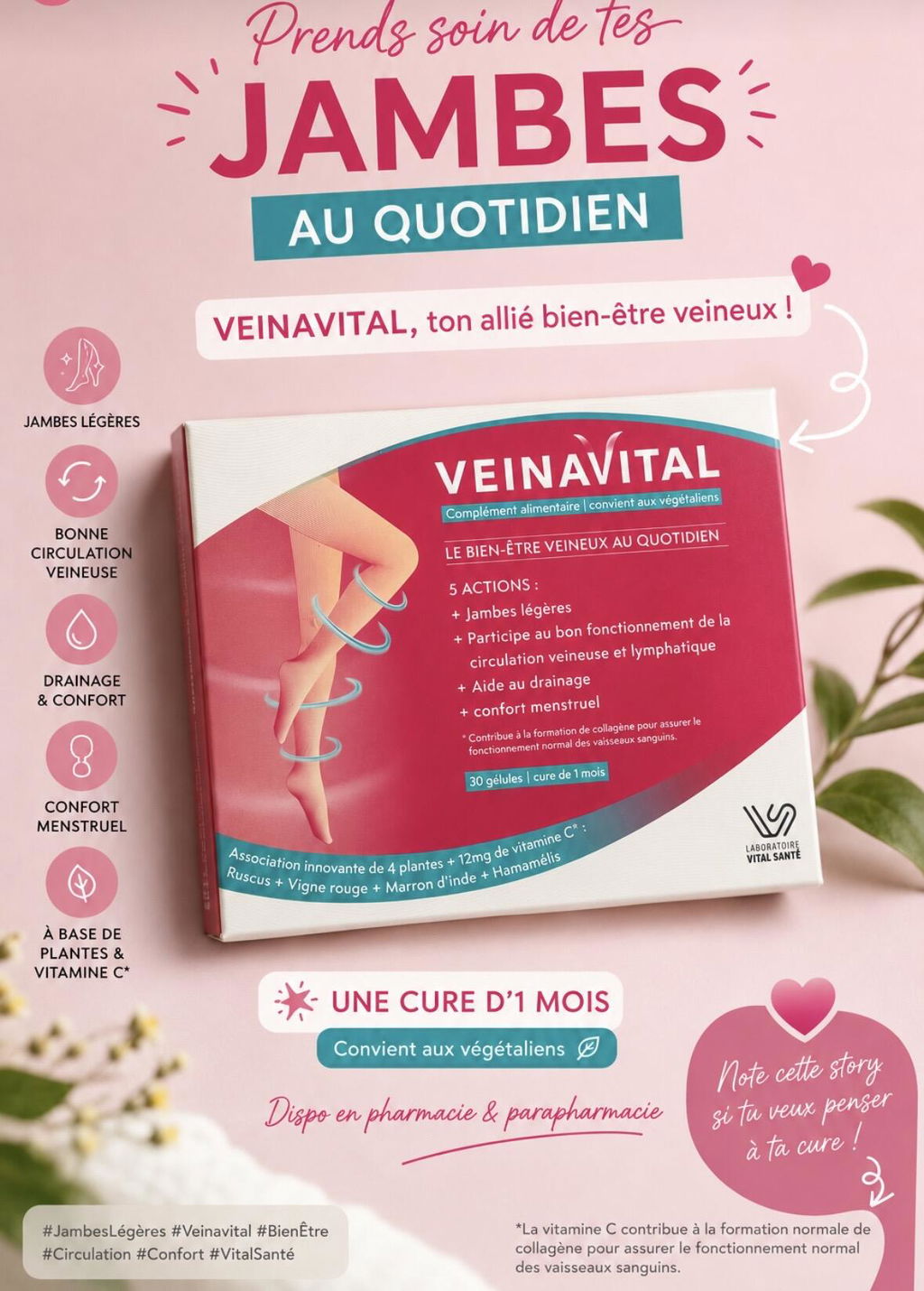
Regular movement remains one of the foundations of venous comfort. In addition to lifestyle measures, Veinavital was developed with the expertise of a vascular doctor. Its formula combines butcher's broom, red vine, horse chestnut and witch hazel with vitamin C.
Vitamin C contributes to the normal formation of collagen necessary for the normal functioning of blood vessels. Veinavital is taken at the rate of one capsule per day, while respecting the precautions for use. A food supplement does not replace a varied diet, physical activity, or treatment when prescribed.
Discover Veinavital and its composition
Frequently Asked Questions About Leg Circulation Exercises
What is the best exercise for blood circulation in the legs?
Walking is generally the most accessible activity: it mobilizes the support of the foot and the calf muscle pump. Ankle bends and tiptoe raises are good additions when it is not possible to walk immediately.
What exercise to do for blood circulation in the feet?
In a seated position, alternate raising your toes then your heels, perform flexion-extension movements and draw circles with your ankles. These movements mobilize the feet, ankles and calf muscles.
What exercises to do when working seated?
Ankle curls, rotations and heel-toe rocking can be done under a desk. They should be accompanied, as soon as possible, by breaks during which you get up and walk for a few minutes.
Should we raise our legs to improve venous return?
Elevating your legs can provide temporary relief after an immobile day. This position is useful as a complement, but it does not replace walking and regular contractions of the calf muscles.
Can we do these exercises with varicose veins?
A gentle activity such as walking is generally recommended to promote venous return. If the varicose veins are painful, are accompanied by significant swelling, skin lesions, or if a procedure has recently been carried out, seek personalized advice from a healthcare professional.
Can these exercises prevent phlebitis?
Moving regularly limits periods of immobility, but these exercises alone do not guarantee the prevention of phlebitis. Certain situations require specific medical measures, particularly after an intervention, during immobilization or in people with risk factors.
To remember
To mobilize the venous circulation of the legs, there is no need for an intense sports session. Simple movements of the feet and ankles, regular contractions of the calves and walking help break immobility and use the natural mechanisms of venous return.
The objective above all is regularity: moving a little, but often, while remaining attentive to unusual symptoms.
This article is provided for informational purposes and does not replace a medical consultation.